

New expert panel launched to help redirect $700bn of farm subsidies and other support to meet climate goals
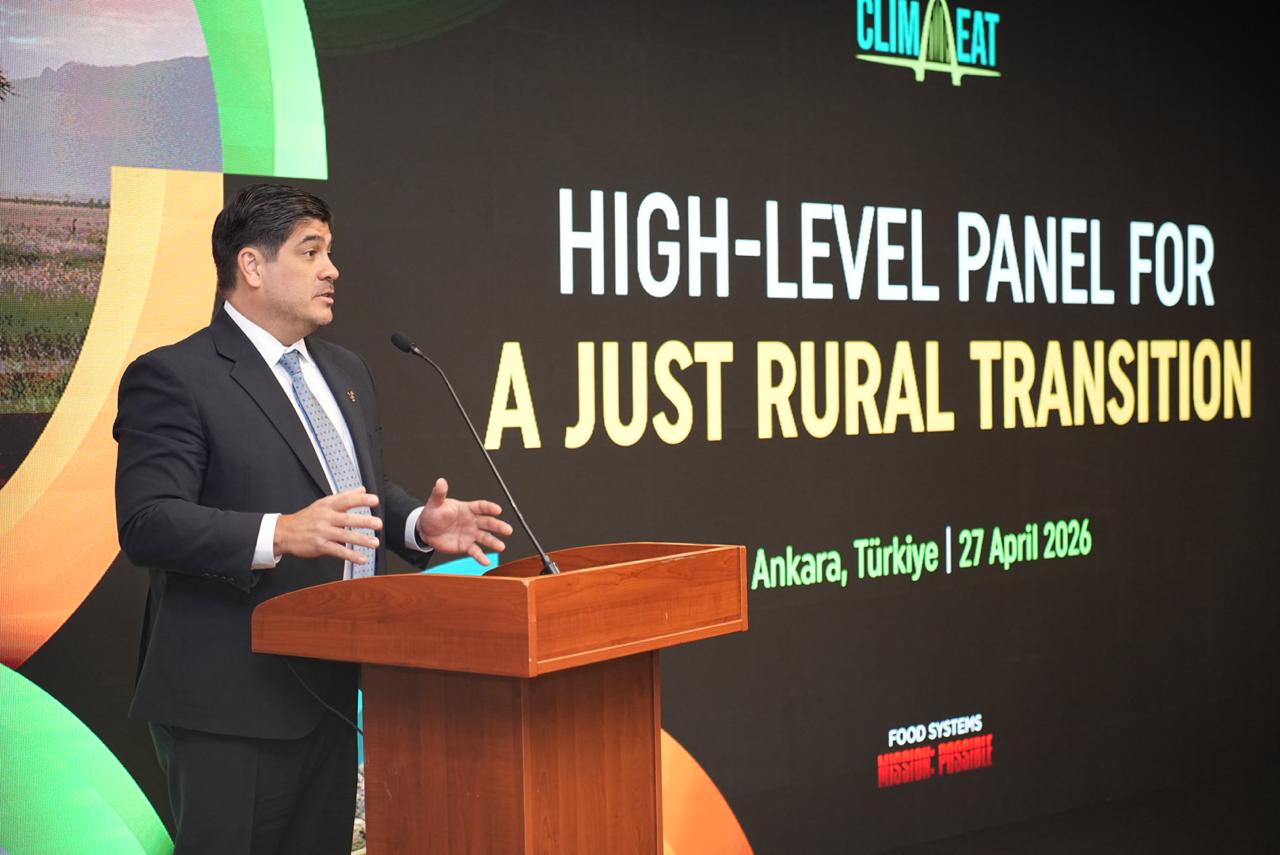
Former Costa Rican President, Carlos Alvarado Quesada, Chair of the New High-Level Panel for a Just Rural Transition, Speaks at the Launch in Ankara, Türkiye
High-Level Panel for a Just Rural Transition launched in Ankara, Türkiye as country prepares to preside over 2026 UN climate talks
ANKARA, TURKEY, April 27, 2026 /EINPresswire.com/ -- A new coalition of global leaders has been launched to help to redirect the $700 billion spent annually on agricultural public support away from fossil fuel-intensive inputs and practices, and toward sustainable, resilient farming that protects livelihoods and the planet.Convened by ‘Think-and-Do Tank’ Clim-Eat as part of the UK-funded Voices for Just Rural Transitions (Voices4JRT) programme, the Panel is chaired by former Costa Rican President Carlos Alvarado Quesada, whose country became the first in the world to introduce a nationwide Payments for Environmental Services Program in 1997.
Panel members include Andrea Meza, Deputy Executive Secretary of the United Nations Convention to Combat Desertification (UNCCD), and Gabriel Cristobal Ferrero De Loma Osorio, former Spanish Ambassador at Large for Global Food Security. The panel also includes representatives from the Gates Foundation, the Alliance for a Green Revolution in Africa (AGRA), and the governments of Türkiye and Malawi.
The Panel’s inaugural session took place in Ankara as Türkiye — represented on the panel by the Directorate of Climate Change — prepares to host the UN climate talks this November. The Panel aims to address how governments can redirect agricultural subsidies toward climate-resilient and sustainable farming practices, supporting farmers and enabling a just rural transition.
Governments spend an estimated $700 billion per year subsidising agriculture, returning just 35 cents of value to farmers for every dollar spent. Around 87 percent of this public support distorts markets and contributes to environmental and social harm. Agricultural public support is a driving force behind the excessive use of fertilizers, contributing to soil degradation, water pollution, and 14 percent of global forest loss every year.
The consequences of an agricultural system built on fossil fuel-dependent inputs have been thrown into sharp relief by recent conflict in the Middle East, as a third of fertilizer passes through the Strait of Hormuz, causing prices to skyrocket by 40 percent. Elevated costs squeeze farmers and deepen food insecurity, leading to severe risks in low- and middle-income countries. This exposes a historic structural vulnerability that public support policies have not yet done enough to address.
The High-Level Panel for a Just Rural Transition has been convened to translate this political moment into action. It will identify where leadership can unlock reform and provide strategic signals to policymakers ahead of key global milestones through 2030. The Panel's design deliberately ensures that the perspectives of farmers and frontline communities inform, rather than follow, high-level policy decisions.
“Repurposing agricultural public support is an evidence‑based source of hope—but it requires the political will to break from business as usual,” said H.E. Carlos Alvarado Quesada, Chair of the High‑Level Panel for a Just Rural Transition. “The issue is not whether governments spend public money on agriculture, but whether those billions are used to reduce fertilizer and fuel shocks and put farmers’ livelihoods and consumers’ wellbeing at the center. This Panel exists to build the coalitions and momentum to make that reform unavoidable.”
The High-Level Panel’s initial mandate covers three focus countries — Brazil, Indonesia and Tanzania. Here, partner organisations are already working directly with farmers and frontline communities through the Voices for Just Rural Transitions (Voices4JRT) initiative to ensure that local perspectives shape the global policy agenda, rather than the reverse.
“There is no single blueprint for reform — political, economic and social contexts vary too widely for any one model to travel unchanged across borders,” said Dr. Dhanush Dinesh, Founder, Clim-Eat. “The Panel is designed to work with governments and stakeholders to identify tailored pathways, exploring alternatives such as smart subsidies conditional on sustainable practices, investment in extension services and rural infrastructure, and direct support for small-scale farmers moving away from fossil fuel-dependent inputs.”
The launch of the High-Level Panel coincides with the First Conference on the Transition Away from Fossil Fuels, which will take place in Colombia. With the global transition away from fossil fuels accelerating and COP31 arriving in Türkiye in November 2026, the pressure on governments to align agricultural spending with climate goals has never been greater. The panel is supported by the UK's Foreign, Commonwealth and Development Office as part of ongoing commitments to climate justice and sustainable food systems when development budgets globally are facing unprecedented pressure.
Harvey Presence
Marchmont Communications
+44 7582 195497
email us here
Legal Disclaimer:
EIN Presswire provides this news content "as is" without warranty of any kind. We do not accept any responsibility or liability for the accuracy, content, images, videos, licenses, completeness, legality, or reliability of the information contained in this article. If you have any complaints or copyright issues related to this article, kindly contact the author above.
